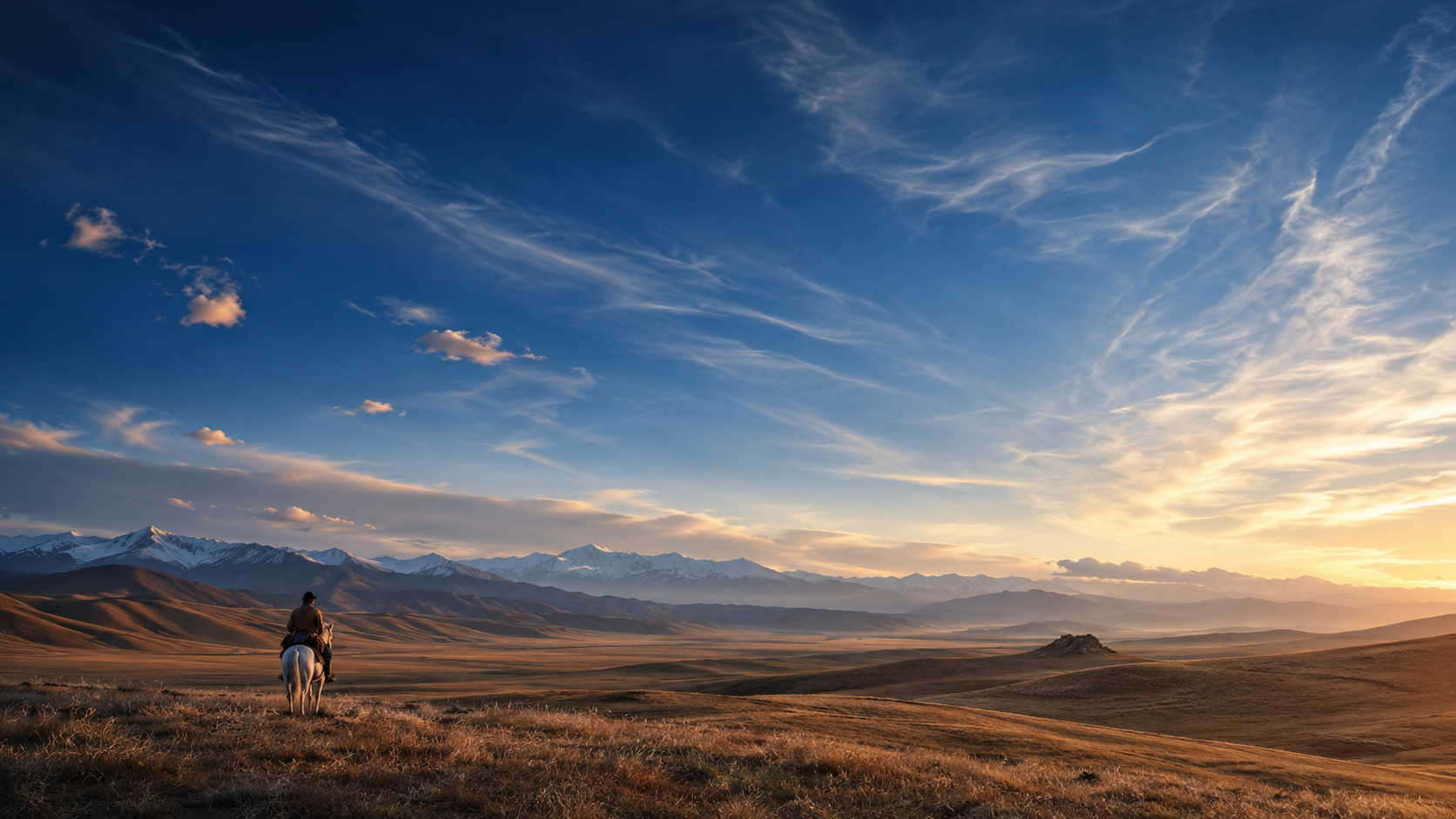
Introduction: The Way of the Eternal Blue Sky
Tengrism is one of the oldest spiritual worldviews associated with the peoples of the Eurasian steppe. It is most often connected with Turkic, Mongolic, and other Inner Asian nomadic cultures, where the vast open sky, the living earth, ancestral memory, and the moral order of the universe were understood as deeply connected parts of life. At the center of this worldview stands Tengri, often translated as Sky, Heaven, God, or Eternal Blue Sky.
But Tengrism is not easy to define with the categories many people use today. It is not a religion in the same sense as Christianity, Islam, Buddhism, or Judaism. It does not have one founder, one holy book, one universal church, or one single doctrine accepted by all followers. It is better understood as a spiritual worldview, a sacred relationship with the cosmos, and a way of living in harmony with Sky, Earth, nature, ancestors, and human responsibility.
For the ancient steppe peoples, the sky was not empty. It was a sacred presence. The earth was not merely land. It was a living foundation. Mountains, rivers, fire, wind, animals, and ancestors were not disconnected from human life. They were part of a larger order. To live well was to live in balance with that order.
This beginner’s guide introduces Tengrism with respect, caution, and clarity. It does not claim to own or define Tengri belief for everyone. Instead, it offers a starting point for people who want to understand the ancient wisdom of the Eternal Blue Sky and its meaning for the modern world.
What Does “Tengri” Mean?
The word Tengri is one of the most important concepts in ancient Turkic and Mongolic spiritual language. In its simplest sense, Tengri means Sky or Heaven. But it can also refer to the supreme divine power associated with the sky, cosmic order, fate, sovereignty, and life itself. In modern Turkish, the related word Tanrı means “God,” showing how deeply this old concept remained embedded in Turkic language and thought.
In ancient usage, Tengri was not usually imagined as a human-shaped god sitting somewhere above the clouds. Tengri was more vast, more abstract, and more cosmic. Tengri could be understood as the living Sky, the divine order of the universe, the source of legitimacy, and the power that watches over human life. Britannica identifies Tengri as an Asian sky god associated with the peoples of Inner Asia, while historical sources connect the term to Turkic and Mongolic traditions.
This is why the phrase Eternal Blue Sky is so important. The sky is visible to everyone, yet impossible to possess. It is above kings and ordinary people alike. It covers all lands, all tribes, all nations, and all living beings. In this sense, Tengri points to both transcendence and nearness: always above us, yet always present.
Is Tengrism a Religion?
The answer depends on what we mean by “religion.”
If religion means a centralized institution with a founder, scripture, priesthood, fixed creed, and formal conversion process, then Tengrism does not fit neatly into that model. Historically, Tengri belief was not organized like a church or mosque. It was woven into the life of nomadic peoples, political authority, family memory, nature, seasonal rhythms, and ritual practices.
If religion means a sacred worldview that explains humanity’s relationship with the divine, nature, death, morality, ancestry, and cosmic order, then Tengrism can certainly be called a religion.
A more careful description would be this:
Tengrism is an ancient spiritual worldview rooted in the sacredness of the Sky, the living Earth, respect for ancestors, harmony with nature, and moral responsibility within the cosmic order.
This definition avoids two common mistakes. The first mistake is reducing Tengrism to only “sky worship.” The second mistake is turning it into a rigid modern doctrine. Tengrism is broader than worshipping the sky, but also more fluid than many institutional religions.
Where Did Tengrism Come From?
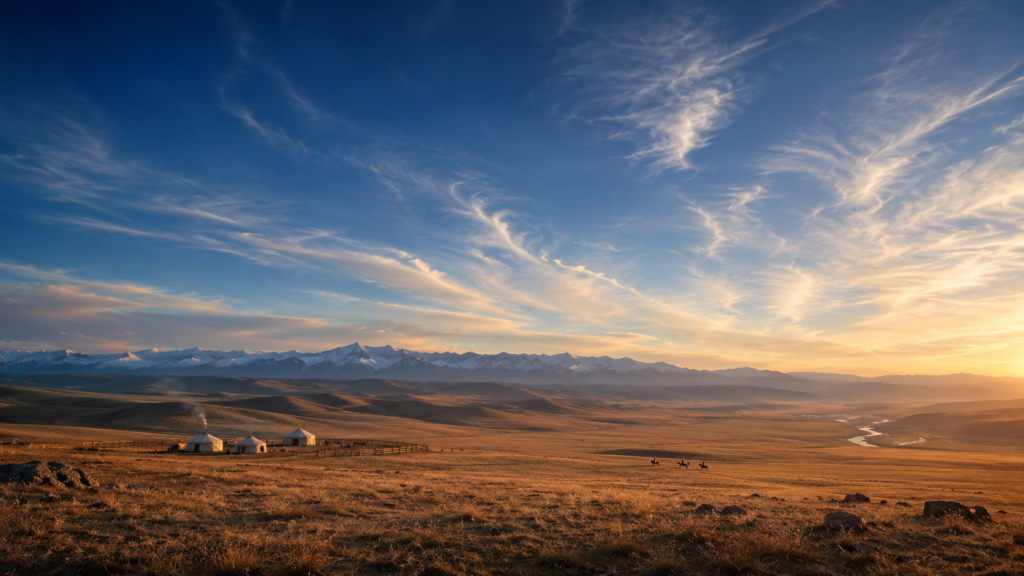
Tengrism developed among the nomadic and semi-nomadic peoples of the Eurasian steppe, especially Turkic and Mongolic societies. These communities lived in close relationship with vast landscapes: open grasslands, mountains, rivers, forests, animals, wind, fire, and changing seasons. Their spiritual imagination reflected that environment.
The Orkhon Valley in modern Mongolia is one of the most important historical landscapes for understanding early Turkic civilization. UNESCO describes the Orkhon Valley Cultural Landscape as an area with archaeological remains dating back to the 6th century and as a place that reflects the relationship between nomadic pastoral societies and their administrative and religious centers.
Among the most important written sources are the Orkhon inscriptions, also called the Orhon inscriptions. These are among the oldest surviving Turkic writings. Britannica states that they were discovered in northern Mongolia in 1889, deciphered in 1893 by Vilhelm Thomsen, and erected in the 8th century in honor of Kül Tigin and Bilge Khagan.
These inscriptions matter because they show that Tengri was not just a vague spiritual idea. Tengri was connected with rulership, destiny, moral order, and the survival of the people. The khagan did not rule only because of military power. He ruled because his authority was understood to be connected with Tengri’s will.
The Core Ideas of Tengrism
Tengrism is not built around a single creed, but several recurring ideas appear across Turkic, Mongolic, and Inner Asian traditions. These ideas should be understood carefully because they vary by people, region, period, and source.
1. Tengri: The Eternal Blue Sky
Tengri is the highest and most central sacred reality in Tengri belief. Tengri is associated with the sky, cosmic order, divine authority, fate, and life. In ancient political thought, rulers could be understood as receiving legitimacy through Tengri’s favor. In everyday spiritual imagination, the sky represented vastness, purity, order, and divine presence.
This does not always mean that Tengrism was strictly monotheistic in the modern theological sense. In many historical contexts, Tengri existed alongside other sacred beings, spirits, ancestors, and forces of nature. A better description is that Tengri was often supreme or central, while the wider spiritual world remained full of living powers.
2. Earth and Nature Are Sacred
In Tengrism, nature is not a lifeless background. The earth, mountains, rivers, fire, forests, animals, and wind are spiritually meaningful. They are part of the living order of existence.
This is especially clear in Mongolic traditions, where Heaven and Earth were both central to the religious imagination. World History Encyclopedia notes that in the Mongol Empire, divine powers of Heaven and Earth were important, with Tengri understood as the “Blue Sky” or “Eternal Heaven,” while Earth or Mother Earth was associated with fertility.
This nature-centered worldview is one reason many modern people feel drawn to Tengrism today. In an age of environmental crisis, urban disconnection, and spiritual exhaustion, Tengri belief offers a way to remember that humans are not separate from the world. We live under the sky, on the earth, among other beings, and inside a larger balance.
3. Ancestors Matter
Ancestor respect is another important part of Tengri-inspired spirituality. Ancestors are not simply dead relatives. They are the memory of the family, the lineage, the people, and the path that made us possible.
In many traditional societies, honoring ancestors does not necessarily mean “worshipping” them in the modern sense. It can mean remembering them, thanking them, learning from them, and recognizing that we are not self-created individuals. We inherit names, languages, stories, wounds, strengths, and responsibilities.
For Tengiway, this distinction is important. A modern and respectful approach should speak of ancestor remembrance, ancestral memory, and respect for lineage, rather than making careless claims about uniform “ancestor worship” across all Tengri traditions.
4. Balance and Moral Order
Tengrism is not only about nature and ancestry. It is also about order. The universe has a balance, and human beings are expected to live responsibly within that balance.
In ancient steppe societies, this could include loyalty, courage, honesty, hospitality, respect for elders, care for the tribe, and responsibility toward the land. The idea of cosmic order was also linked with political legitimacy. A ruler who lost wisdom, justice, or heavenly favor could be seen as losing the right to rule.
This is one of the most powerful ideas in Tengri belief: human life is not random. Actions matter. Leadership matters. Character matters. Harmony between Sky, Earth, ruler, people, family, and nature matters.
5. The Role of the Kam or Shaman
Many Tengri-related traditions include spiritual specialists often described as kam, böö, or shamans, depending on the language and culture. These figures could act as mediators between the human world and the spirit world. They might perform healing, divination, ritual, communication with spirits, or ceremonies connected to ancestors and nature.
However, it is important not to reduce Tengrism entirely to shamanism. Tengrism and shamanic practices overlap, but they are not identical. Shamanism describes a set of ritual practices and spiritual techniques found in many cultures around the world. Tengrism is a broader Inner Asian worldview in which Tengri, nature, ancestors, spirits, and social order all play roles.
A careful sentence would be:
Tengrism often includes shamanic elements, but it should not be reduced to shamanism alone.
Tengrism and the Ancient Turks
Among ancient Turkic peoples, Tengri was deeply connected to political and spiritual life. The Orkhon inscriptions show a world in which the fate of the Turks, the authority of the khagan, and the order of the people were described in relation to Heaven.
The inscriptions are especially important because they are not later legends written centuries after the fact. They are early Turkic monumental texts from the 8th century. Britannica describes them as the oldest extant Turkish writings and notes that they relate the origins, golden age, subjugation, and liberation of the Turks in an epic style.
For modern readers, this means Tengrism is not merely an invented fantasy or internet trend. It has historical roots in real texts, real landscapes, and real civilizations. At the same time, we must be honest: modern Tengrism is not always a direct continuation of one unchanged ancient system. Much of what exists today is a revival, reconstruction, reinterpretation, or cultural return.
That honesty makes the tradition stronger, not weaker.
Tengrism and the Mongol World
Tengri was also central in Mongolic traditions. In the Mongol Empire, the idea of Eternal Heaven played an important role in imperial legitimacy. Mongol rulers often invoked the power of Eternal Heaven in official language, and the sacred order of Heaven was connected with authority, victory, and destiny.
World History Encyclopedia explains that the Mongols regarded Tengri, also called the Blue Sky or Eternal Heaven, as the main divine power and that official Mongol documents often referenced the power of Eternal Heaven. It also notes that prayer could be simple and did not require elaborate buildings or ceremonies.
This simplicity is important. In many Tengri-related traditions, the sacred is not locked inside a building. The open sky itself can become the temple. A mountain, river, fire, or quiet place under the sky can become a point of connection.
This is one reason Tengrism can speak powerfully to modern city life. Even in New York, London, Berlin, Istanbul, Almaty, Bishkek, or Ulaanbaatar, the sky is still above us.
Does Tengrism Have a Holy Book?
No single holy book defines Tengrism for all followers.
There are important historical sources, myths, inscriptions, chronicles, oral traditions, ethnographic records, and modern studies. The Orkhon inscriptions are among the most important early Turkic sources. Mongolic texts and oral traditions also preserve important elements of Tengri-related belief. But there is no equivalent of the Bible, Quran, Torah, Guru Granth Sahib, or Buddhist canon in Tengrism.
This can be difficult for modern people to understand because many are used to religions being text-centered. Tengrism is more landscape-centered, memory-centered, and practice-centered. Its “scripture,” if we use the word poetically, is written in the sky, the earth, the ancestors, the wind, the fire, the herd, the mountain, and the moral life of the people.
Does Tengrism Have Rules?
Tengrism does not have one universal legal code accepted by all followers. There is no single list of commandments that all Tengri believers must follow.
But this does not mean it has no ethics. Its ethical vision is rooted in balance, responsibility, respect, and harmony. A person should live in a way that does not break the order between human beings, nature, ancestors, and the sacred.
A modern Tengrism-inspired ethical path may include:
Respect the Sky as a reminder of humility.
Respect the Earth as a living foundation.
Honor your ancestors without becoming trapped by the past.
Live truthfully and keep your word.
Protect nature and avoid waste.
Respect animals and other living beings.
Serve your family and community.
Act with courage, discipline, and gratitude.
Seek balance rather than domination.
These are modern expressions, not a claim that every ancient Turkic or Mongolic group followed the exact same written code. That distinction matters.
Is Tengrism Monotheistic, Polytheistic, Animistic, or Shamanic?
This is one of the most common questions beginners ask. The honest answer is: Tengrism does not fit perfectly into one modern category.
It can appear monotheistic when Tengri is understood as the supreme God or highest divine reality.
It can appear polytheistic when other deities, spirits, and sacred beings are included.
It can appear animistic because mountains, rivers, fire, animals, and natural forces may be understood as spiritually alive or meaningful.
It can appear shamanic because ritual specialists may communicate with spirits and perform healing or ceremonial work.
Instead of forcing Tengrism into one category, it is better to understand it as a cosmic and relational worldview. It describes a universe filled with sacred relationship: Sky above, Earth below, ancestors behind, nature around, and responsibility within.
Tengrism and Other Religions
Tengrism has existed alongside many other religions throughout history, including Buddhism, Islam, Christianity, Manichaeism, and local folk traditions. Turkic and Mongolic peoples did not all follow one religious path forever. Over centuries, many converted to Islam, Buddhism, Christianity, or other traditions, while older Tengri-related ideas often remained in language, ritual, worldview, folklore, and cultural memory.
For example, the Orkhon Valley later became important not only for Turkic and Mongol imperial history, but also for Buddhist monastic traditions. UNESCO notes that the Orkhon Valley includes evidence of Turkic memorial sites, Uighur and Mongol capitals, and early Mongol Buddhist monasteries, showing the layered religious history of the region.
This layered history is important for Tengiway’s approach. Tengrism should not be used as a weapon against other religions. Many people today may feel connected to Tengri belief culturally or spiritually while also coming from Muslim, Buddhist, Christian, secular, or mixed backgrounds.
A respectful modern approach should make room for complexity.
Modern Tengrism: Revival, Reconstruction, and Living Memory
Modern Tengrism is growing in visibility, especially among people interested in Turkic and Mongolic heritage, Central Asian identity, nature-centered spirituality, and ancestral memory. Since the collapse of the Soviet Union, many communities in Central Asia and the broader Turkic world have revisited pre-Islamic and pre-Soviet cultural roots.
But modern Tengrism is also debated. Scholars have noted that some modern forms of Tengrism are connected with national revival, identity politics, and the reconstruction of tradition. One academic discussion of modern Tengrism describes it as part of the relationship between national rebirth and renewed ethnic faiths in post-Soviet Central Asia.
This does not mean modern Tengrism is fake. Many living traditions are revived, reinterpreted, and reconstructed after periods of disruption. What matters is honesty. A serious Tengri platform should distinguish between:
historically attested beliefs,
regional folk practices,
modern interpretations,
personal spiritual practices,
and political uses of the tradition.
Tengiway’s approach should be clear: we honor the ancient roots, study the historical sources, respect regional differences, and explore modern practice without pretending that every modern idea is ancient.
Common Misunderstandings About Tengrism
Misunderstanding 1: “Tengrism is only sky worship.”
Tengri is central, but Tengrism is not only about the sky. It includes Earth, nature, ancestors, spirits, morality, community, and cosmic balance.
Misunderstanding 2: “Tengrism is just shamanism.”
Tengrism often includes shamanic elements, but it is broader than shamanism. Shamanism refers to certain ritual roles and techniques; Tengrism refers to a wider sacred worldview.
Misunderstanding 3: “Tengrism belongs to only one nation.”
Tengri belief is associated with many Turkic, Mongolic, and Inner Asian peoples. No single modern nation owns it completely.
Misunderstanding 4: “Modern Tengrism is exactly the same as ancient Tengrism.”
Modern Tengrism often includes revival, reconstruction, research, and personal interpretation. That should be acknowledged honestly.
Misunderstanding 5: “Tengrism must be anti-Islam, anti-Christian, or anti-Buddhist.”
This is not necessary. Tengrism can be studied and practiced as ancestral heritage, cultural memory, or spiritual path without attacking other religions.
How Can Someone Practice Tengrism Today?

Because Tengrism has no single global institution, modern practice varies widely. Some people approach it as a religion. Others see it as ancestral heritage. Some treat it as a philosophy of nature and balance. Others combine it with cultural, artistic, or ecological practice.
A respectful modern Tengri-inspired practice might include:
Spending time under the open sky.
Observing nature with gratitude.
Honoring ancestors through remembrance.
Learning the history of Turkic, Mongolic, and Inner Asian peoples.
Reducing waste and living with ecological responsibility.
Creating simple rituals around water, fire, stone, wood, or sky.
Practicing silence, reflection, and humility.
Building community with others interested in Tengri wisdom.
Protecting cultural heritage from distortion and political misuse.
It is important to say “Tengri-inspired” when describing modern practices that are not directly documented from historical sources. This keeps the path honest and respectful.
Why Tengrism Matters Today
Tengrism matters today because many modern people feel spiritually homeless. They live in cities, separated from nature, separated from ancestors, separated from silence, and separated from the sky. Tengrism offers a language for reconnection.
It reminds us that the sky is still sacred.
It reminds us that the earth is not a resource to exploit without limit.
It reminds us that ancestors are not gone if we carry memory responsibly.
It reminds us that freedom without order becomes emptiness.
It reminds us that identity is not only politics; it can also be responsibility, gratitude, and service.
It reminds us that the human being is not above nature, but inside nature.
For people of Turkic, Mongolic, Central Asian, Siberian, and steppe heritage, Tengrism can also become a path of cultural remembrance. For people outside those backgrounds, it can be approached respectfully as a wisdom tradition connected to the ancient human relationship with sky, land, and life.
What Is Tengiway’s Approach to Tengrism?
Tengiway does not claim to be the owner, final authority, or official voice of Tengri belief.
Tengiway exists to study, preserve, explain, and respectfully explore Tengri belief for the modern world.
Our approach is based on five principles:
1. Learn with honesty.
We study historical sources, academic research, oral traditions, and cultural memory without pretending that every question has a simple answer.
2. Practice with respect.
We explore modern Tengri-inspired practices while clearly distinguishing them from historically documented traditions.
3. Honor nature.
We see Sky, Earth, water, fire, mountains, rivers, animals, and forests as reminders of the sacred relationship between human life and the living world.
4. Remember ancestors.
We treat ancestral memory as gratitude, responsibility, and continuity, not as empty nostalgia.
5. Build community.
From New York to the world, Tengiway aims to connect people, researchers, cultural groups, and communities interested in Tengri belief and steppe heritage.
A Simple Definition of Tengrism
If you are new to the subject, remember this definition:
Tengrism is an ancient Turkic-Mongolic and Inner Asian spiritual worldview centered on Tengri, the Eternal Blue Sky, and shaped by reverence for nature, respect for ancestors, cosmic balance, and the moral responsibility of human beings within the living universe.
This definition is not perfect, because no short definition can capture the full depth of a living and evolving tradition. But it is a strong place to begin.
The Sky Is Still Above Us
Tengrism begins with a simple truth: the sky is still above us.
Empires rise and fall. Languages change. Religions meet, merge, and transform. Cities grow where grasslands once stretched. People migrate far from the lands of their ancestors. But the sky remains.
To look at the sky with awareness is to remember humility.
To touch the earth with respect is to remember belonging.
To honor ancestors is to remember continuity.
To live with balance is to remember responsibility.
Tengrism is not only about the past. It is also a question for the present:
How should we live under the Eternal Blue Sky?
That is the question Tengiway seeks to explore.